
Finding My Way Back
Sep 23, 2026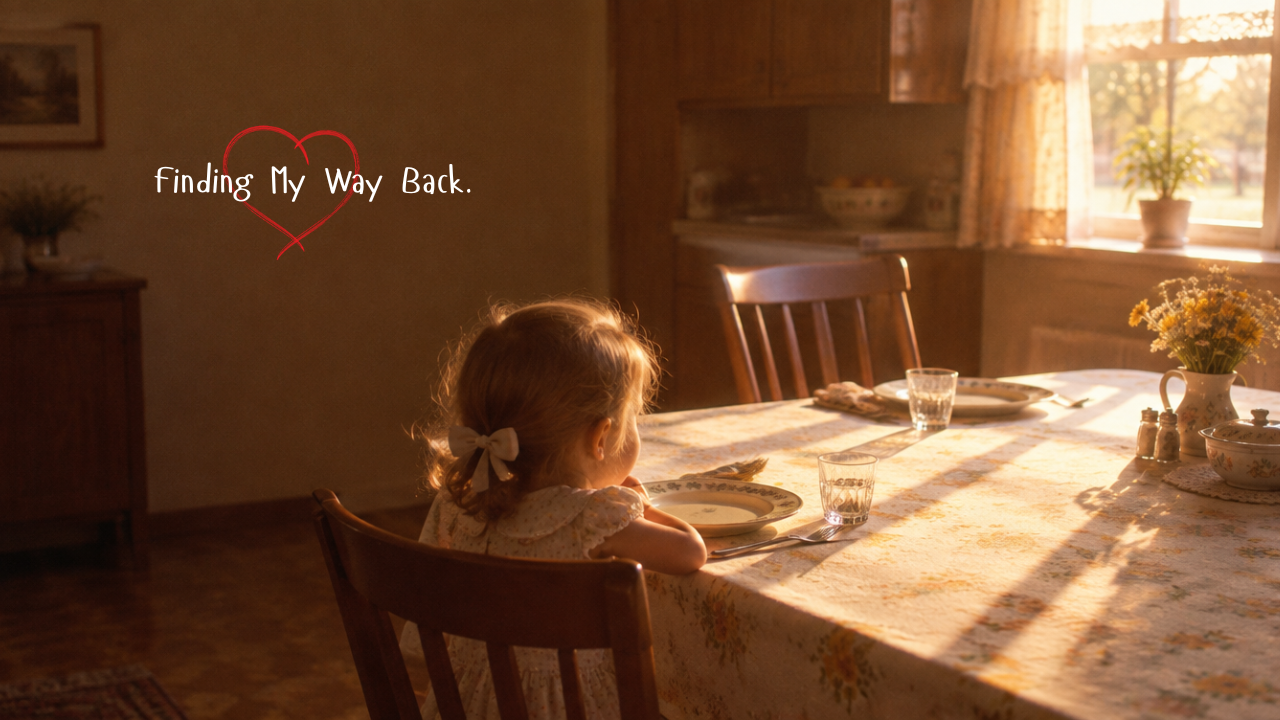
Last week, I wrote about discovering that some of the love I had for myself came with fine print. I also promised to go a little deeper into what I've learned about loving ourselves when we wander away from the person we want to be and find our way back again.
Because loving ourselves is one thing. Figuring out how to do it is another.
I've spent a good portion of my adult life figuring that out, and here's the first thing I wish I'd understood much earlier: start underneath the behavior.
We tend to start with what we're doing wrong. Why do I keep choosing people who aren't good for me? Why can't I say no? Why do I care so much what people think? Why do I keep overeating, overspending, procrastinating, overworking, or putting everyone else first?
Those are useful questions, but I've found another one much more useful:
What would I have to believe about myself for this behavior to make sense?
That question changed things for me.
When I was three and a half, my father left our family after something happened at the dinner table. My little-girl mind connected what I had said with his leaving. I caused this. And eventually that became something deeper: There must be something wrong with me. Maybe I'm not worthy of being loved.
I didn't consciously walk around believing that for the next several decades. That's what made it so powerful. It became an undercurrent, affecting how I interpreted what happened around me before I even knew I was interpreting it.
Years later, I was in a car accident and immediately told the police officer it was my fault. It wasn't. But through the lens I was using at the time, my response made perfect sense. Something bad happened, so I looked at Diana.
That's where I think we begin. Find the belief, not just the behavior.
For someone else, the belief may be I'm too much or I'm not enough. Maybe it's people leave, my needs are selfish, or I have to earn love. Some of us learned that keeping everyone happy keeps us safe.
You may have formed that belief when you were five, fifteen, or forty-five. Maybe someone told you directly. More often, I think we piece these things together ourselves from what happened to us, and then we begin living as though our interpretation is a fact.
Once I began finding mine, I had to question them. And I don't mean putting an affirmation on my bathroom mirror telling myself I was worthy.
I tried things like that.
My brain is quite willing to argue with a Post-it note.
I had to go back and look at the actual story. Could a three-and-a-half-year-old child really cause the breakup of a marriage? Of course not. That sounds obvious now, but understanding something intellectually and releasing a belief you've carried for years are very different things.
For me, that took repetition. Writing helped enormously. So did the Enneagram because it showed me patterns I'd been living inside without recognizing them. There were also times when another person reflected something back to me that I couldn't yet see for myself.
Gradually, I learned something that has been enormously important: a feeling isn't necessarily evidence.
Feeling guilty doesn't mean I'm guilty. Feeling rejected doesn't mean I'm unworthy. Someone being unhappy with me doesn't automatically mean I've done something wrong, and fear doesn't always mean I should stop.
Making a mistake doesn't mean I am one.
Learning to separate what happened from what I made it mean about me has probably changed my life as much as anything I've done.
Then came the less glamorous part: actually living what I'd learned.
That's mostly practice, and I'm afraid I haven't found a shortcut. We catch ourselves doing the old thing and try something different. Then eventually we catch ourselves a little sooner.
Maybe you notice yourself saying yes when you want to say no. You hear an apology coming out of your mouth for something that doesn't require one. You realize you're looking to someone else for reassurance because you've temporarily lost your own footing. Or you hear that familiar voice telling you, See? You screwed up again.
I've come to believe those rather unremarkable moments are where much of the real work happens. It's easy to feel enlightened at a workshop. One afternoon when you're pissed off, scared, embarrassed, or halfway through doing the thing you swore you weren't going to do again is a better test.
And what I need in those moments isn't always the same.
There are times when I need to change my behavior or apologize. There are others when I need to stop assuming responsibility for something that was never mine. And every once in a while, I need to admit, “Well, that wasn't my finest hour,” figure out what I can learn from it, and get on with my life.
Forgiveness has become a big part of that for me.
For years, I think I confused forgiving myself with letting myself off the hook. I don't see it that way anymore. Forgiveness doesn't erase responsibility. For me, it means responsibility gets to have an ending.
That's especially important when I've hurt someone I love. Those mistakes are still the hardest for me to let go of. But continuing to hurt myself doesn't undo what happened to someone else. I can repair what I can, learn from it, and change what needs changing without reopening the case every few days to make sure I still feel sufficiently bad.
That has taken me a long time to learn.
So when I talk about finding my way back to myself, I don't mean I've discovered some beautiful little formula.
For me, it has meant getting curious enough to find the old story underneath my behavior and brave enough to question whether it's true. Then I have to notice where I'm still living as though it is, make a different choice when I can, and forgive myself when I don't.
And yes, I get to do that more than once.
I've been at this for decades, and old stories still occasionally show up wearing new clothes. The difference now is that I recognize them much sooner, and I don't automatically believe everything I think about myself.
I know myself better. I trust myself more. And when I wander away from the woman I want to be, I don't turn it into evidence that I've failed at loving myself.
I know the way back now.
And these days, I get there a hell of a lot faster.
Love is ALL there is,
Diana
